
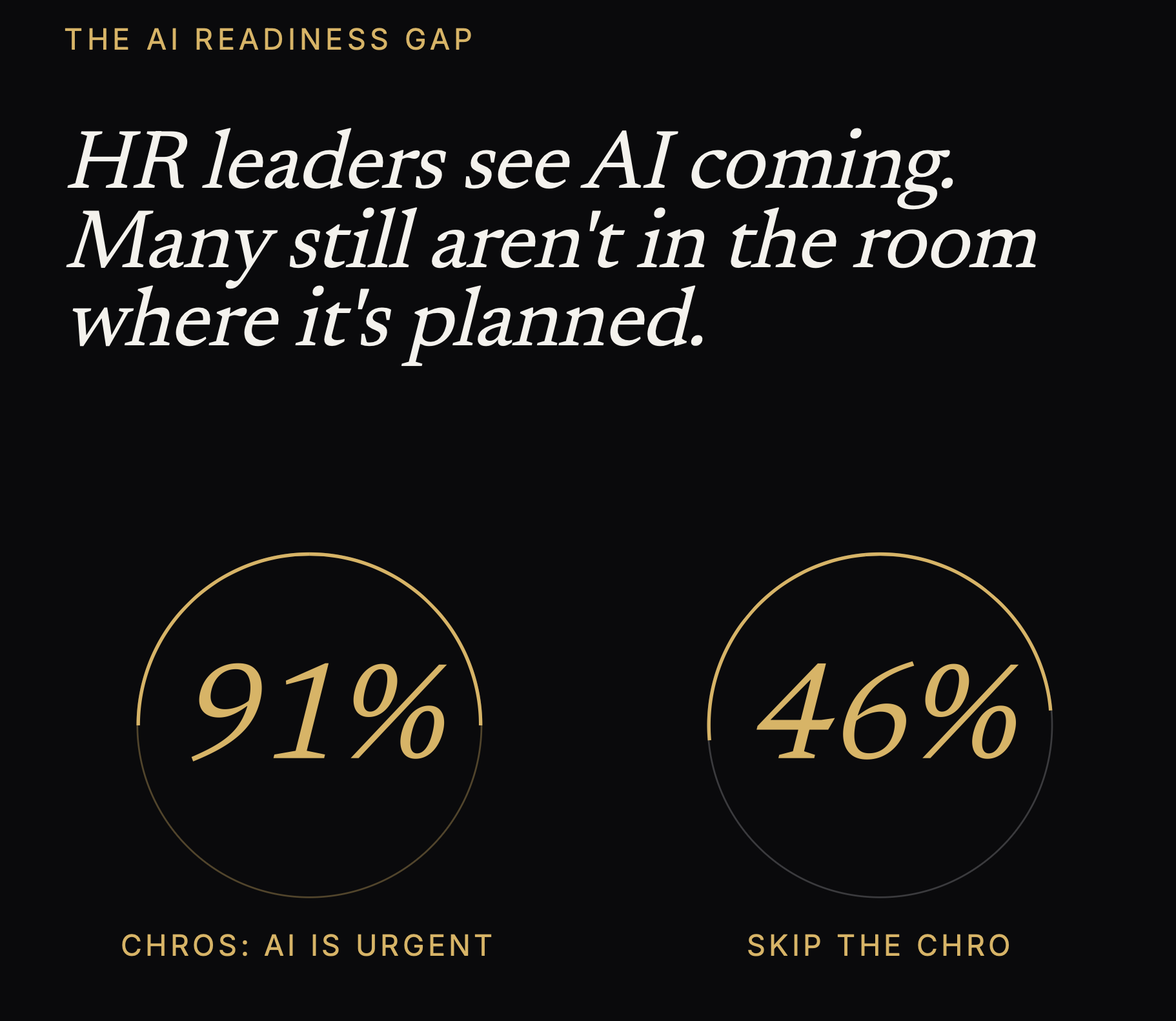
AI is quickly becoming one of the most important priorities for HR leaders. In the CHRO Association’s 2026 survey, 91% of respondents selected AI and workplace digitization as an immediate concern.
Yet recognizing the importance of AI is not the same as helping shape its direction. IBM’s 2026 CHRO study found that 46% of organizations do not involve the CHRO when defining AI strategy.
For forward-thinking CHROs, that gap represents an opportunity. Companies need leaders who can help redesign workflows, prepare employees, and translate AI adoption into measurable business results. A CHRO who can do that has a compelling reason to be part of the strategy conversation.
The most valuable opportunity for HR leaders in AI may not be automating HR work. It may be helping the company solve a problem that no single department can solve alone: turning AI investment into measurable business results.
For a CHRO who wants to contribute more directly to growth and strategy, that creates a practical opening. AI is changing workflows, roles, and the skills organizations need. Those changes touch the entire business, and they require more than a technology rollout.
The question is not whether HR should replace the CIO or CTO. It is how a CHRO can become the executive partner who makes AI transformation work across teams.
In an episode of SageCreek AI’s Where AI Fits podcast, Connor McLeod speaks with Chris Linford, vice president of human resources at Ampetronic | Listen Technologies and executive sponsor of its AI initiative. Her path offers a useful lesson: influence grows when you demonstrate business value, not when you ask for a larger title.
The opening: own a business problem, not an AI tool
A CEO is unlikely to sponsor an AI initiative simply because employees could benefit from learning new technology. The stronger case starts with a business bottleneck: delayed delivery, costly handoffs, slow decisions, inconsistent quality, or work that keeps experienced people from higher-value tasks.
CHROs have an advantage here. They already work with leaders across departments and see how responsibilities and incentives affect execution. That vantage point can help them connect a specific business problem with the people and process changes required to fix it.
Chris puts this in business terms in the podcast. A people-centered company must also be viable and growing. Revenue, efficiency, and employee opportunity are connected. The CHRO who understands that connection can participate in conversations about how the company performs, not only how it manages employees.
A six-step path to becoming an AI transformation partner
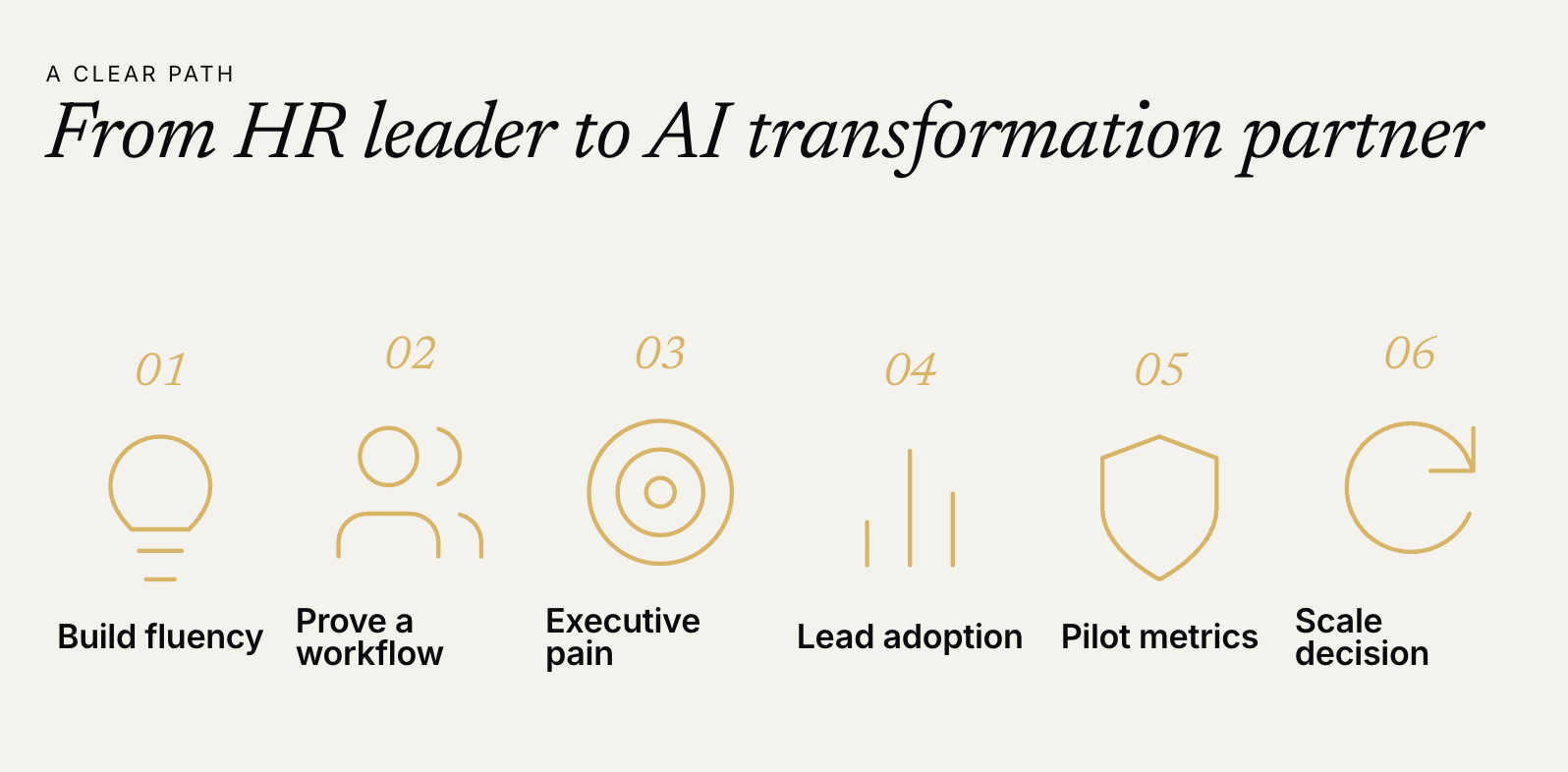
- 01Build your own fluency before proposing a company-wide program.
Chris began by experimenting with AI in her own work. She later showed her HR team how to use prompts to work through real recruiting and benefits problems. That firsthand experience mattered: she could describe what AI was good at, where its output needed review, and why training should start with actual work.
You do not need to become an engineer. You do need enough practical experience to ask useful questions and recognize when a proposed use case is unrealistic.
- 02Prove the method on a workflow you know.
Chris used AI to help develop and compare 58 job descriptions. When a manager considered changing roles on a team, the analysis surfaced a different staffing approach, including a potentially lower-cost position and an opportunity to grow talent internally. In another project, she piloted individualized onboarding plans built from job descriptions and answers to 12 manager questions.
The takeaway is not that every CHRO should build these same tools. It is that a small, credible example gives you something concrete to bring to a business conversation: the original problem, what changed, the human review involved, and the potential benefit.
- 03Find the pain point another executive already wants solved.
Meet with the COO, CIO, CTO, or a business-unit leader. Instead of opening with “Where could your team use AI?” ask where work gets stuck, what delays revenue or delivery, and which recurring decisions absorb skilled employees’ time.
Then map the current workflow with the people who own it. Chris emphasizes that adding AI to a bad process can simply amplify the problem. Some steps may be automated; others may need to be redesigned or removed. Human judgment should remain where accountability and context matter.
- 04Offer to lead adoption alongside the technical owner.
Not every CEO will assign enterprise AI to HR. Chris is clear that her executive sponsorship at Listen is unusual, and she advises HR leaders to work closely with whoever already owns the initiative.
A stronger proposal than “Let HR run AI” is: “You own the technology and security decisions. I can help identify the teams affected, build the training and communication plan, support managers, and measure whether people actually adopt the new workflow.”
This is a partnership, not a turf battle. It puts the CHRO in a role that matters to the success of the project.
- 05Run a pilot with a business metric and a people metric.
Choose one bounded workflow with a clear owner and a manageable level of risk. Agree in advance on what success looks like. Depending on the process, the business metric might be cycle time, rework, cost, throughput, or time to proficiency. The people metric might be adoption, employee confidence, training completion, or the quality of human review.
Chris argues for pilots because they make room for experimentation and feedback. They also create early wins that can reduce skepticism. Employees need to see how a change helps them do better work, not just hear that leadership expects them to use AI.
- 06Bring the results back as a scale-up decision.
When the pilot ends, return to the executive team with a short, decision-ready summary: the problem, baseline, redesigned workflow, measured results, risks, employee feedback, and the next investment required. Be candid about what did not work.
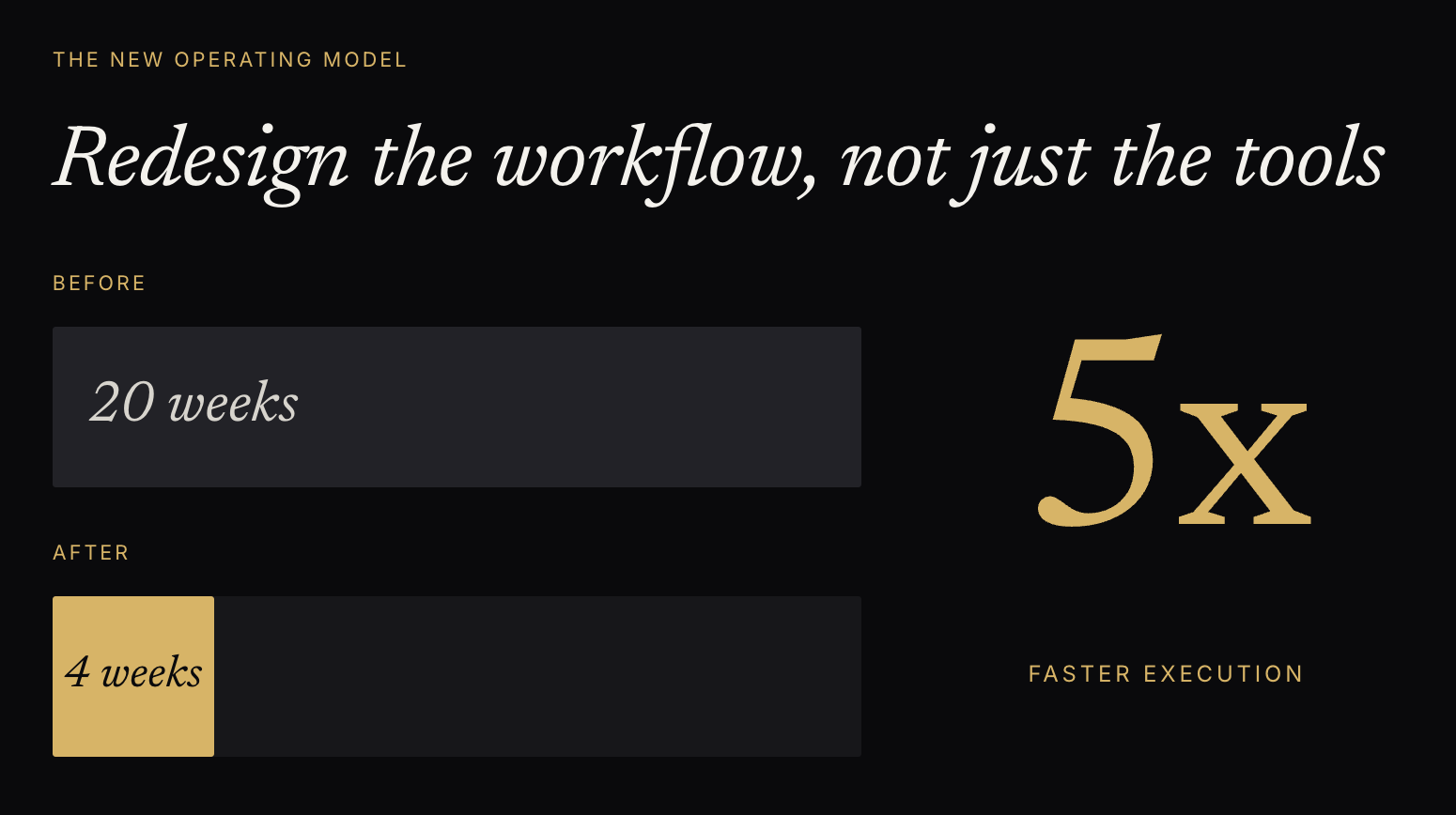
Business impact is what makes these efforts worth sponsoring. In one SageCreek AI client engagement, a redesigned brand integration process reduced the timeline from 20 weeks to four. The work was not about teaching employees to use a new tool; it was about changing a business workflow and accelerating execution. See the Axia Partners case study.
What executive sponsorship actually looks like
An AI transformation sponsor does not have to choose the model, write code, or own every vendor decision. The sponsor helps keep the effort tied to company priorities and ensures that technical work becomes operational change.
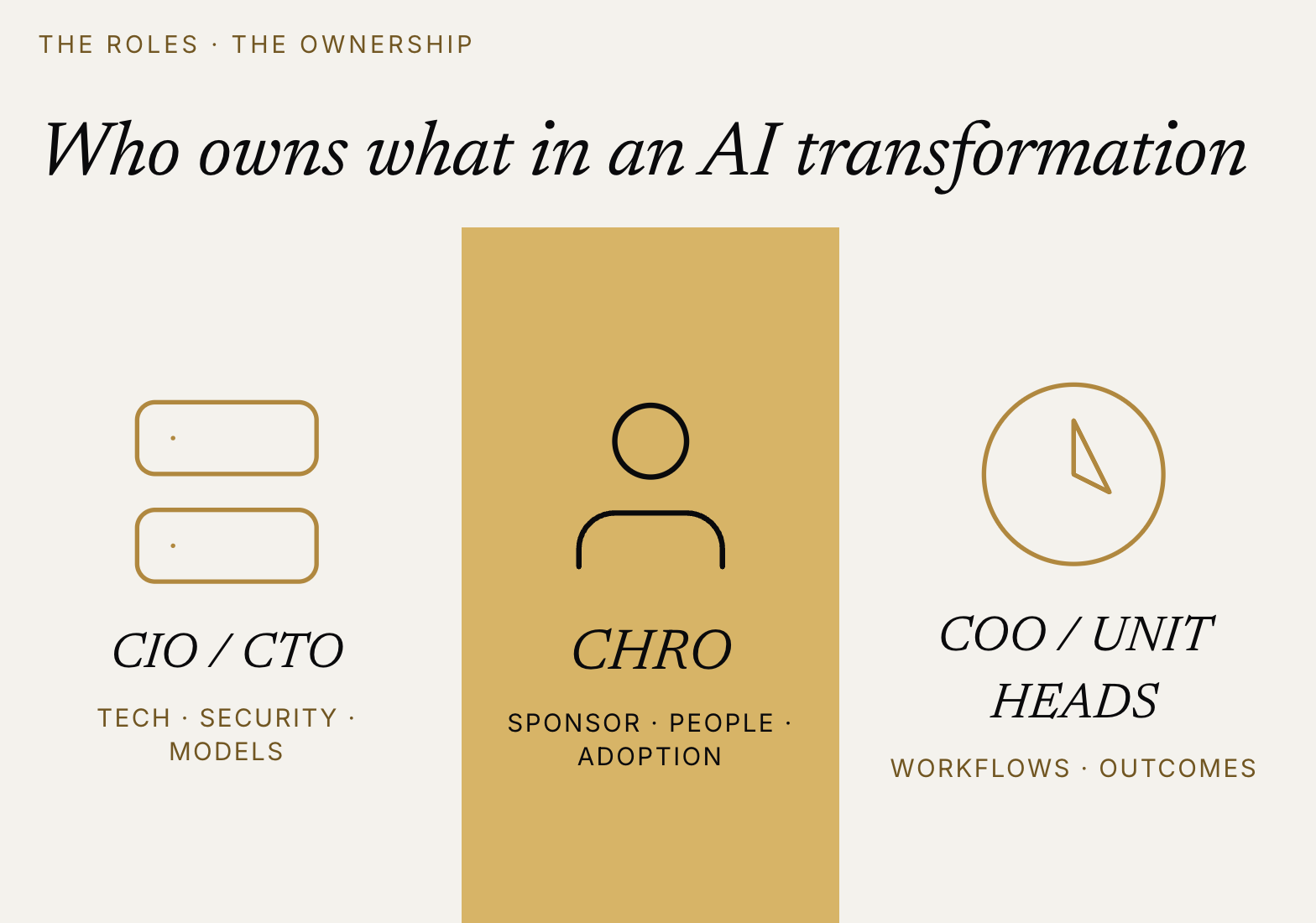
For a CHRO, that can mean convening functional leaders, building workforce readiness, helping redesign responsibilities, aligning managers, and communicating the purpose of the change. Technical leaders remain accountable for architecture, integrations, and security. Business leaders remain accountable for their outcomes. HR helps connect those pieces so the initiative can scale.
This is also why the work cannot stop at AI literacy. Employees can attend training and still return to the same inefficient process. The more valuable question is whether a team can do its work differently, safely, and better than before.
Where SageCreek AI fits
For CHROs, the difficult first step is often translating a broad ambition into a credible business initiative. Which workflow deserves attention? What can AI realistically improve? What technical support is required? And how should the company test value before committing to a larger rollout?
SageCreek AI works from the business problem outward, helping organizations identify AI opportunities and develop solutions around real workflows. That gives an HR leader a way to approach a CEO or technology partner with a defined opportunity rather than a general request to invest in AI.
The CHRO brings the cross-functional relationships, workforce perspective, and change-management capabilities. Business and technical partners bring the domain knowledge and implementation expertise. Together, they can build a program that has a reason to exist beyond adopting the latest tool.
A better seat at the table is earned through results
Chris did not begin by claiming to be the most technical executive in the room. She learned the tools, demonstrated their usefulness, understood the company’s needs, and volunteered to help lead a transformation that would affect everyone.
That is the opportunity for CHROs now: become the person who can connect AI investment to how the business actually works. Start with one problem worth solving, build the right partnership, and bring back evidence that the organization can act on.
Turn AI opportunity into executive influence
The opportunity for CHROs is not simply to advocate for AI adoption. It is to help identify where AI can create meaningful value across the organization and build a strategy for making it happen.
SageCreek AI’s AI Opportunity Audit helps leadership teams map workflows, identify high-impact opportunities, evaluate technology and data readiness, and prioritize initiatives by their potential effect on revenue and margin. For a CHRO looking to bring a credible proposal to the executive team, that is a practical place to start.
Not ready for a deeper engagement? Start with the free, two-minute AI Readiness Assessment to see where your organization stands and which areas deserve attention first.